
How to Build an Evidence-Ready Project Plan
Learn how to build an evidence-ready project plan by linking obligations, owners, acceptance criteria, review points, and status reporting.

An evidence-ready project plan treats proof of work as a planned deliverable. It does not wait until project close to ask people for screenshots, approvals, test records, or decision logs that may be incomplete, outdated, or difficult to trace.
Completing an activity, recording that it occurred, and producing evidence that a qualified reviewer can evaluate are different outcomes. A task can be marked complete while the required approval is missing, the record covers the wrong version, or nobody has confirmed that the artifact meets the expectation it is meant to support.
This article provides an operational planning method for connecting requirements, work, proof, review, and decisions. It can improve review preparation, but it does not determine whether an organization is compliant, certified, legally defensible, or ready to pass an audit. Applicable obligations, evidence standards, retention requirements, and approval authority vary by context.
Evidence-ready means the proof is planned with the work
For each important obligation, control expectation, contractual commitment, or internal requirement, make the proof lifecycle visible before execution begins. Identify the work to perform, the artifact expected from that work, the producer, the reviewer, the acceptance condition, and the decision point the evidence supports. The Evidence-Ready Work Record later in this article provides a compact way to keep those fields connected.
This distinction also appears in formal assessment settings. NIST SP 800-53A describes assessment methods that can include examining, interviewing, and testing relevant assessment objects to obtain evidence. That is a NIST assessment model, not a universal checklist, but it illustrates why a folder of attachments is not enough. A reviewer needs enough context to determine what an artifact represents and whether it meets the relevant expectation.
For cybersecurity risk management, NIST CSF 2.0 includes legal, regulatory, and contractual requirements in an organization's context. The broader planning lesson applies outside cybersecurity: preserve the source expectation, identify who can interpret it, and turn its operational implications into scheduled work.
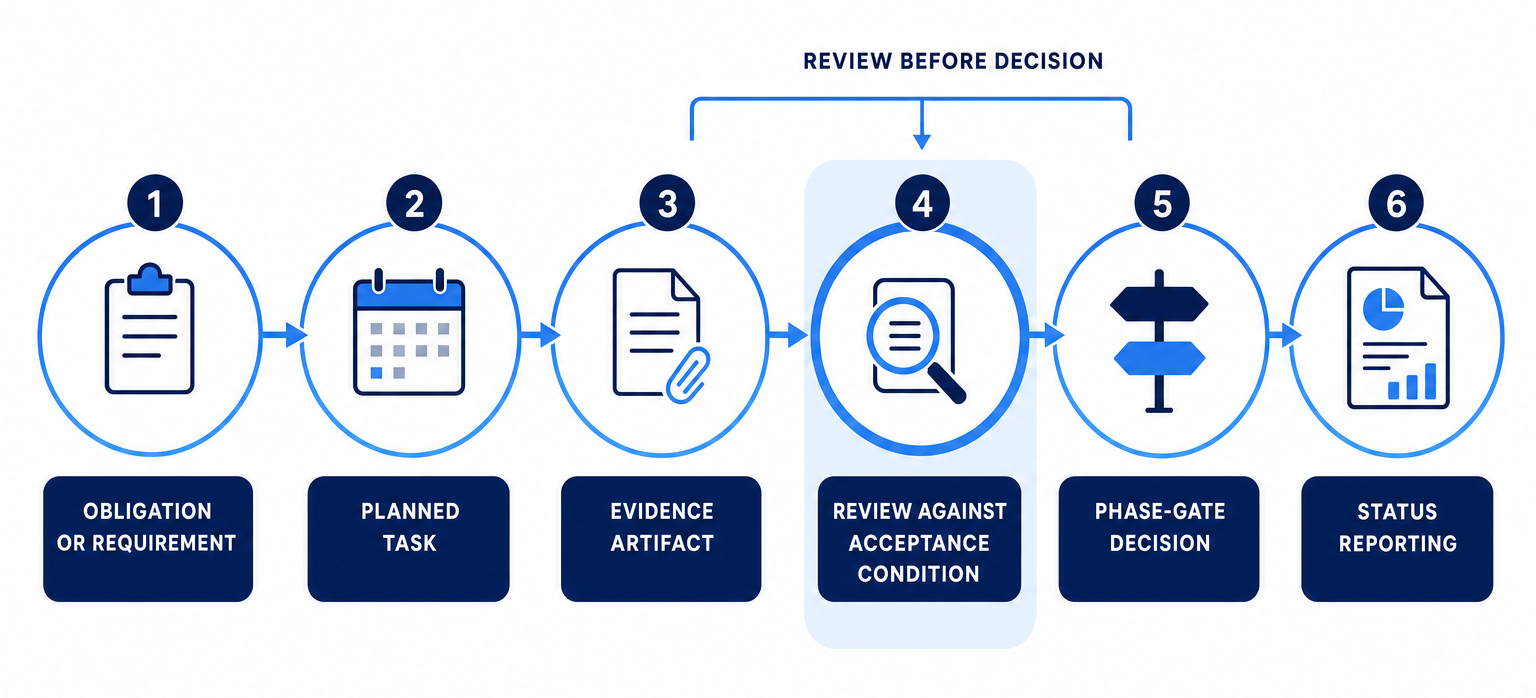
Translate each obligation into a testable work record
Do not paste broad source language into a schedule and call it a task. Retain a reference to the authoritative source and any approved interpretation, then identify the specific activities needed to address it. This preserves traceability while keeping the plan usable by the people doing the work.
Consider a hypothetical requirement that production access must be approved before use. The plan may need separate work for defining approval criteria, requesting access, completing the approval, retaining the decision record, and checking that approval is present before release. The evidence artifact might be an attributable approval record tied to the relevant person, environment, and access request. The release check is separate work because it confirms that the evidence is available when the decision is made.
One obligation can require several activities and artifacts. A single task can also support more than one obligation. Treating the relationship as strictly one-to-one creates false simplicity and can hide work that belongs in the schedule. The planning objective is a traceable record that lets the team see what must happen, what proof should result, and who decides whether it is sufficient for the intended review.
Use the Evidence-Ready Work Record below as an editorial planning framework. It is not a formal control-assessment method or a universal evidence schema. It keeps the source expectation, delivery activity, proof, accountability, timing, and review decision connected.
Planning field | What to define | Example question |
|---|---|---|
Obligation or requirement | The source expectation and approved interpretation | What exactly must this work support? |
Planned activity | The task, review, test, or operational change | What work will address the expectation? |
Evidence artifact | The proof expected from the work | What can a reviewer examine, verify, or trace? |
Producer and reviewer | Creation and review responsibilities | Who prepares it, and who can accept it? |
Acceptance condition | Completeness, attribution, period, version, and approval criteria | What makes this artifact fit for review? |
Due point and dependency | The milestone, handoff, or phase gate it supports | When must review finish so it does not delay delivery? |
Storage context and status | Authoritative location and current state | Where is the current record, and is it planned, produced, reviewed, or accepted? |
The evidence artifact does not always need to be a document. Depending on the applicable requirement and assessment approach, useful evidence may include configuration output, a training record, a test result, a signed review, an interview record, or a decision log. Define the expected artifact early enough that the team can create it in the normal course of work rather than reconstructing it later.
Assign a producer, reviewer, and acceptance condition
“The project team” is rarely a useful evidence owner. Assign a producer who creates or gathers the artifact and a reviewer who can assess it against the stated condition. Where the work requires a separate approval decision, name the accountable approver as well. The same person may fill more than one role in a small or low-risk project, but the decision authority should still be explicit.
Define acceptance before the artifact exists
An acceptance condition describes what makes evidence fit for its intended review. At a minimum, state the expected artifact, the period or version it covers, required attribution or approval, completeness criteria, and the standard or interpretation the reviewer will apply. For example, “access approval attached” is weak. “Approval record identifies the requester, requested production role, approver, decision date, and approved access scope before release” gives the producer and reviewer something concrete to assess.
A document existing is not the same as a document meeting an acceptance condition. It may be unsigned, tied to an outdated version, missing a required field, or stored where the reviewer cannot establish that it is the current authoritative record. Separating production from review makes those gaps easier to identify before they become a release or closeout problem.
NIST CSF 2.0 treats governance as including roles, responsibilities, authorities, policies, processes, and oversight. Use that as a bounded example of why named authority matters. It does not mean every project requires the same role structure or a formal security governance model.
Put evidence checkpoints in the schedule, not after it
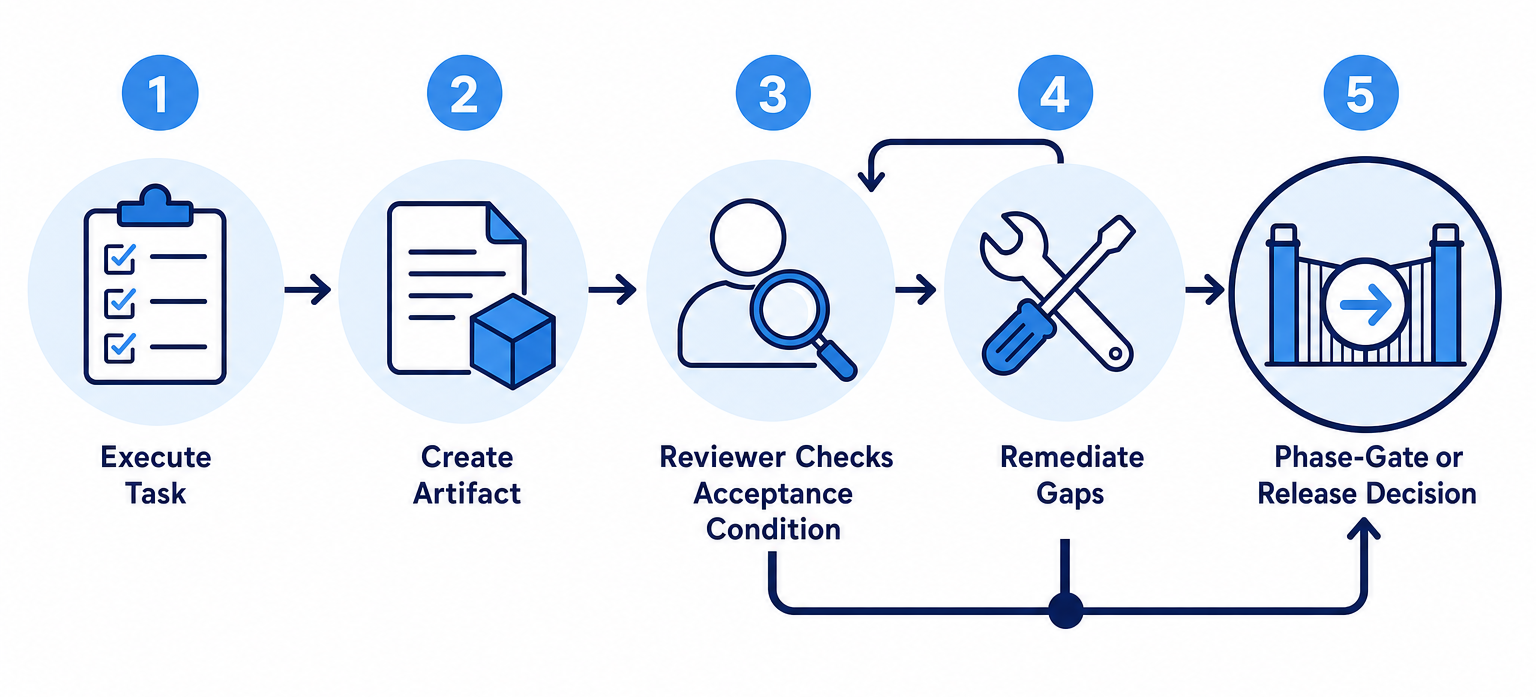
Evidence work belongs beside the activity that produces it. If a team performs a test, completes a configuration change, delivers training, or approves a decision, the plan should include the corresponding artifact creation and storage step in that part of the schedule. A single “collect evidence” task at closeout obscures dependencies and makes it hard to see what is actually missing.
Use a simple dependency pattern: perform the work, produce the artifact, review it against the acceptance condition, remedy gaps, then approve the phase gate or proceed to the release decision. The review and remediation steps must finish before the milestone that depends on them. Otherwise, the milestone is a target date rather than a meaningful decision point.
Avoid four common scheduling failures
- Using task completion status as proof that acceptable evidence exists.
- Scheduling evidence review on the same day as the release, handoff, or phase gate.
- Leaving no time to correct rejected, incomplete, or stale artifacts.
- Assigning a reviewer after the work is already complete.
NIST SP 800-53A states that its assessment procedures can be executed at various phases of the system development life cycle. That guidance applies to the NIST assessment context, but it supports a useful general planning principle: staged review is more manageable when it is built into delivery rather than deferred to the end.
Report evidence coverage without claiming compliance
Stakeholders need visibility into whether required proof is being planned and reviewed. They do not need a project manager to make a legal, regulatory, contractual, certification, or audit determination from a status report. Report the operational state of the work, then make unresolved exceptions visible.
- Obligations mapped to planned work
- Evidence artifacts planned
- Evidence produced
- Evidence under review
- Evidence accepted
- Evidence rejected or stale
- Unresolved exceptions and their next decision point
For each missing, rejected, expired, or disputed artifact, add a short exception narrative: what is absent or unsuitable, who owns the next action, what decision is affected, and when the issue will be reviewed again. This gives leaders a usable risk signal without implying that all mapped work is satisfactory.
Use terms such as “evidence coverage,” “artifact status,” and “review status.” Avoid calling a project compliant or audit-ready unless an authorized assessment process has reached that conclusion. NIST assessment procedures and evidence expectations are tailored to the applicable context and risk tolerance, and other governing requirements may use different standards.
Use one connected view for tasks, obligations, and evidence
A planning record is most useful when it stays close to the work. PortfolioStack project archetypes provide structured task breakdowns that can include compliance obligations and evidence requirements. On project detail pages, readers can inspect connected planning context in Plan, Rules, and Measures views before deciding whether a project is a useful starting point.
After adding a project to a portfolio, the Grid task detail panel displays a task's obligations and evidence alongside editable task information. This gives the delivery team a place to manage work status while retaining the context that explains why the task matters. Use that context to schedule evidence production and review as part of normal execution, not as a separate closeout exercise.
PortfolioStack's Metrics Dashboard also displays compliance rings for the percentage of obligations addressed and evidence produced by completed tasks. These are coverage indicators. They can help a team identify missing planning or execution links, but they are not a compliance determination, an audit result, or proof that a control is effective.
Start with a relevant structured project archetype, then adapt the tasks, owners, dates, and review points to the governing requirements and decisions in your environment. Browse project archetypes.
Start exploring now
Search the catalog, review project details, and see how PortfolioStack works before creating an account.