
Project Roles in Small Teams: How to Avoid Accountability Collisions
Use a lightweight accountability map to clarify project roles, prevent approval bottlenecks, and manage workload when small teams wear multiple hats.

Small teams do not need to eliminate multiple hats. They need to make the relevant roles visible when work, decisions, review, and escalation meet. A delivery lead may also be the subject-matter expert. A founder may approve a release and manage the client relationship. Those combinations can work. The operating problem starts when nobody can say who owns the next action, who can make the decision, or where a problem goes when the person doing the work is unavailable.
A lightweight accountability map helps a small team answer those questions without building a large PMO artifact. It borrows the useful core of a responsibility-assignment matrix: connect specific work with the roles participating in it. For critical work, it also makes the review path and escalation route explicit.
Small teams need clearer roles, not more layers
When a five-person team takes on several initiatives, informal coordination can feel efficient. People know one another, decisions happen in chat, and the same person can move from configuring a system to answering a client question in an afternoon. That speed disappears when a handoff is unclear or a decision waits on someone who did not realize they owned it.
The goal is not to assign a distinct person to every project role. That is rarely realistic. The goal is to identify the work where ambiguity is expensive: a customer commitment, a budget-affecting choice, a key dependency, a release approval, an evidence review, or a problem that could interrupt delivery. For those work packages, name the delivery owner, decision path, review path, and escalation route.
Responsibility-assignment matrices are commonly used to connect project activities with the roles involved in them. They can help teams make ownership visible, identify work with no clear role coverage, and support a practical workload conversation. They do not guarantee good governance or successful delivery. Their value depends on whether the team uses the map to resolve real ambiguity.
Separate participation from accountability
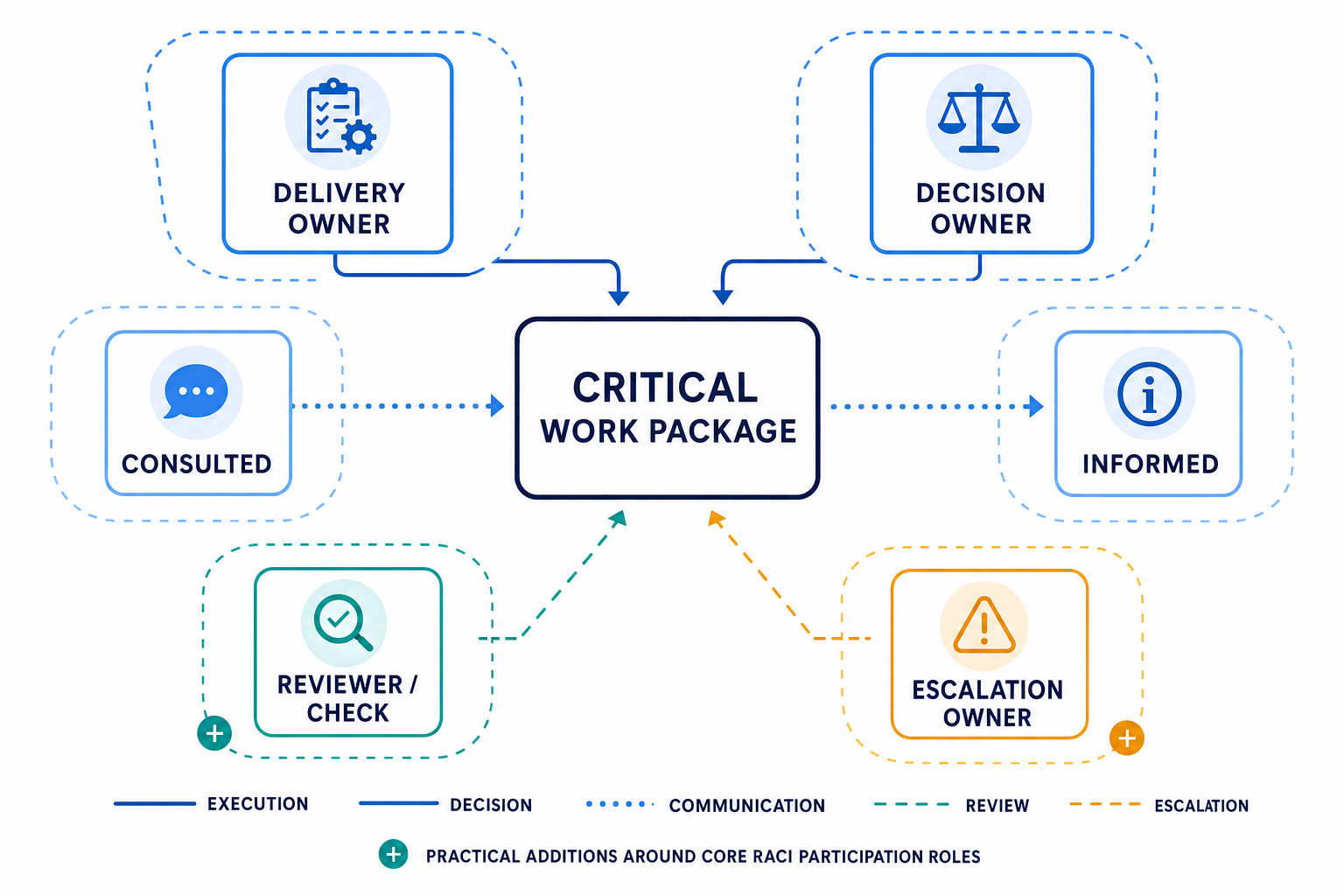
RACI is a useful starting vocabulary. In the common convention, Responsible is the role that performs or coordinates the work. Accountable is the role that owns the decision or outcome. Consulted roles provide input before an action or decision. Informed roles need to know what happened, but do not need to participate in producing the result. Government, university, and project-management guidance use this structure to make relationships between work and roles visible.
For small teams, basic RACI labels often leave two practical questions unanswered. First, who provides a meaningful check when a work package deserves one? Second, who receives and moves an issue forward when the normal delivery path is stuck? Add a reviewer or check field and an escalation-owner field for critical work. These are planning fields, not replacements for RACI and not formal control requirements.
- Delivery owner: the role coordinating or completing the work.
- Decision owner: the role authorized to accept the outcome, choose a direction, or make a tradeoff.
- Consulted: roles whose input changes the work or decision.
- Informed: roles that need a timely update.
- Reviewer or check: the role or mechanism used to challenge, sample, verify, or accept important work.
- Escalation owner: the role responsible for moving a blocked or material issue to the appropriate decision-maker.
Assign these fields to a work package, approval, handoff, or decision. Do not treat them as permanent labels attached to a person. Start with role titles such as Operations Lead or System Administrator, then record the person currently filling that role. This makes the structure easier to maintain when staffing changes.
Four accountability collisions to surface early
1. The delivery owner also approves the deliverable
A person may be the best equipped to produce a deliverable and to confirm that it is ready. In a small team, that may be the only practical arrangement. The risk is not the combined title by itself. The risk is that assumptions, omissions, or incomplete evidence never receive a second look.
For material work, decide what an appropriate check looks like. It could be a sampled review by another teammate, a challenge question in a decision meeting, customer acceptance, or an explicit decision to accept the risk without an additional check. Record the choice. If the work includes evidence or approval records, the team may also find it useful to link the review path to its broader approach for building an evidence-ready project plan.
2. The subject-matter expert is also the final reviewer
The only person who understands a specialized workflow is often asked to define the requirements, configure the solution, and judge whether it works. Their expertise is essential. It can also make underlying assumptions hard for the rest of the team to see.
Use a deliberate challenge mechanism where practical. Ask another role to test a requirement from the user or client perspective. Have the expert state the assumptions that would invalidate the result. If no alternate reviewer is available, document what was checked, what was not checked, and who accepted the remaining risk. The point is to make the decision visible, not to create performative independence.
3. The project manager owns every decision
A project manager can coordinate decisions without being the right decision owner for all of them. If every scope choice, budget tradeoff, priority conflict, and release approval waits for one person, dependent work can stall even when the team has enough delivery capacity.
Set delegation boundaries before pressure builds. Define which decisions the delivery lead can make, which require an operations or executive owner, and what threshold turns a routine issue into an escalation. Name a backup for decisions likely to arise during absences or peak delivery periods. This keeps decisions close to the work while preserving appropriate authority.
4. The client lead also owns escalation
The person managing a client relationship has valuable context. They may also be responsible for maintaining communication while an issue needs a decision from elsewhere in the organization. Without an agreed route, a material issue can remain within the relationship longer than the delivery situation warrants.
For client-impacting risks, define where issues go if the relationship owner cannot resolve them. A separate escalation owner, a scheduled risk review, or an agreed forum with an executive sponsor may be enough. The important detail is that the route exists before a missed commitment turns into a surprise.
Build a lightweight accountability map for the work that matters
Keep the first map small. A useful version for a five- to ten-person team can fit on one page and cover only the work where a delay, weak handoff, or unclear decision would matter. Do not assign letters to every minor task. Map the work packages, decisions, approvals, handoffs, and escalations that shape delivery.
- Select the critical work. Include external commitments, approvals, dependencies, high-cost decisions, and customer-impacting issues.
- List the roles needed for each item. Use role titles before individual names.
- Assign a delivery owner and a decision owner. For material work, recommend one clearly named decision owner unless the team has deliberately defined shared accountability and a tie-break path.
- Add consultation, review, and escalation paths where they will change the outcome or reduce avoidable delay.
- Test the map with the people doing the work. Ask where they would go if a decision, review, or dependency fails.
Hypothetical example: a six-person organization is rolling out an internal operational system. Roles are illustrative, not a prescribed staffing model. The same role appears in more than one column because the team is small. The final column turns those overlaps into explicit discussion items.
Work package or decision | Delivery owner | Decision owner | Consult or review | Escalation owner | Collision to discuss |
|---|---|---|---|---|---|
Approve requirements | Operations Lead | Operations Sponsor | System Administrator, Client Lead | Operations Sponsor | Does the Operations Lead have authority to resolve scope tradeoffs, or must they escalate? |
Configure workflow | System Administrator | Operations Lead | Process Expert reviews assumptions | Operations Lead | The Process Expert is also the requirements source. What challenge check will test the configuration? |
Validate results | System Administrator | Operations Lead | Process Expert checks sample outcomes | Operations Sponsor | If the same roles configured and validated the work, is a sample check or acceptance decision needed? |
Approve go-live | Operations Lead | Operations Sponsor | System Administrator, Client Lead | Operations Sponsor | Is the sponsor available by the decision deadline, and who is the backup? |
Resolve client-impacting issue | Client Lead | Operations Sponsor | Operations Lead, System Administrator | Executive Sponsor | Can the Client Lead escalate a material issue without delaying the client conversation? |
A blank, unowned, or overloaded column is a discussion prompt. It is not a reason to invent a role that the organization does not have. The team may choose a backup, change a decision threshold, reduce the scope of a release, or accept a documented risk. What matters is that the choice is explicit and connected to the work.
Review role conflicts alongside workload and sequencing
Review the map at kickoff, at major phase or decision gates, when staffing changes, and whenever a delivery date or priority materially changes. These are the moments when a reasonable role design can become unworkable. A person who was an appropriate reviewer for one work package may become the decision owner, reviewer, and escalation path across several deadlines in the same week.
Look beyond assigned delivery tasks. Ask whether one role is repeatedly named as decision owner, reviewer, or escalation owner for work due in the same window. Then compare that concentration with dependencies. A delayed approval can block work just as effectively as a lack of delivery hours. For the broader capacity view, see capacity planning across projects.
In PortfolioStack, tasks include owner roles, and the portfolio Metrics Dashboard provides a workload breakdown by owner role. Selecting an owner can filter the Grid to that role's relevant tasks. That visibility can help a team see where responsibility is concentrated. It does not determine decision rights, reviewer independence, or an appropriate escalation path. Teams still need to define those choices for the work they are running.
Start with one active initiative. Map five critical work packages, identify the role collisions, and agree on the few review, backup, and escalation decisions that will prevent avoidable waiting. Then carry the method into the next project instead of rebuilding role clarity from scratch.
Browse project archetypes and inspect the roles attached to the work.
Start exploring now
Search the catalog, review project details, and see how PortfolioStack works before creating an account.